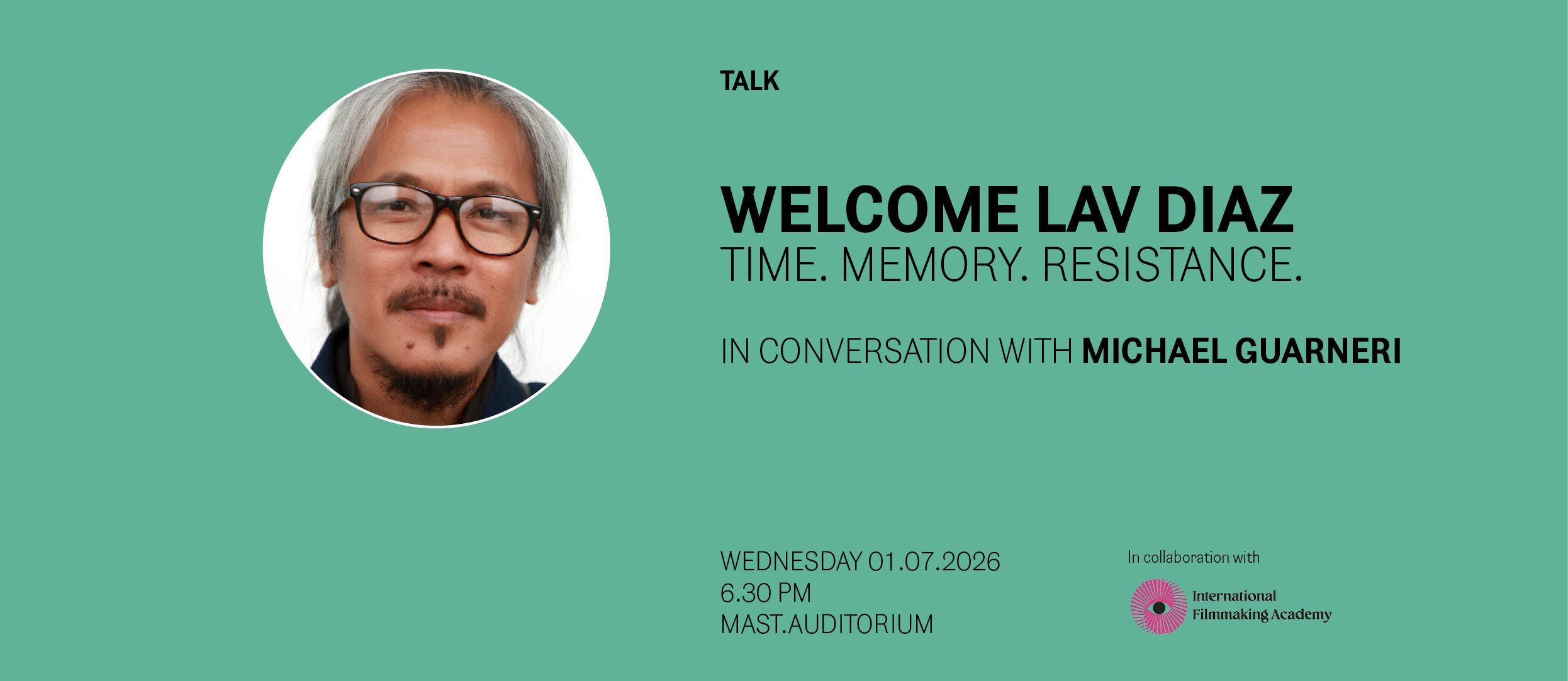
The Fondazione MAST is delighted to welcome the Filipino director Lav Diaz, one of the most important filmmakers in world cinema and winner of the Golden Lion at Venice, the Golden Leopard at Locarno and the Silver Bear at Berlin.
By rejecting conventions, Lav Diaz has developed a deeply personal form of expression characterised by a radical approach to cinematic time, transforming cinema into a space for political, philosophical and emotional reflection. His works create a space where past and present intertwine, prompting reflection on the mechanisms of memory, oblivion and historical identity. One of the most visionary voices in contemporary cinema, Diaz will be in conversation with Michael Guarneri, a film critic, exploring his work and his vision of cinema.
In collaboration with the International Filmmaking Academy, where Lav Diaz is Master Teacher 2026.
FREE ADMISSION BY RESERVATION
Lav Diaz, born in the Philippines in 1958, is a director, screenwriter, producer, director of photography, editor and actor. Deeply influenced by the Philippines’ complex colonial past and political instability, his films explore the scars left by dictatorship, revolution and social injustice. His works create a space where past and present intertwine, prompting reflection on the mechanisms of memory, forgetting and historical identity. What sets Diaz apart is his radical approach to cinematic time. Rejecting the conventions of mainstream cinema, he employs extreme running times, long sequence shots and minimalist storytelling. A central element of his style is the use of black and white, which lends the images a timeless and symbolic quality. Among his most important works are Norte, the End of History (2013), From What Is Before (2014) and The Woman Who Left (2016), all of which have been internationally acclaimed and honoured at major festivals, including Venice and Locarno. In his most recent work, Magellan (2025), Diaz continues his historical exploration by focusing on the figure of Ferdinand Magellan, addressing themes such as colonialism, power and identity through his unmistakably contemplative gaze.